Security managers face a constant challenge: how do you verify guards are actually completing their patrol routes? The answer has evolved from unreliable manual systems to intelligent, automated verification.
The Problem with Manual Systems
Traditional patrol verification methods create more problems than they solve:
Paper logbooks can be filled out in advance or falsified after the fact. A guard can sign all checkpoints from the security desk without ever walking the property. There's no way to verify authenticity or timing.
GPS location tracking shows where a phone is, but not whether the guard physically inspected the area. A guard can drive past checkpoints or leave their phone in a vehicle while taking breaks. GPS alone doesn't prove presence or thoroughness.
Manual check-in calls rely on guards remembering to report in. They're easily forgotten during busy shifts and provide no documentation trail for compliance or liability purposes.
These systems create liability risks and make it impossible to ensure consistent security coverage.
What Are NFC Tags?
NFC (Near Field Communication) tags solve these verification problems with simple, reliable technology.
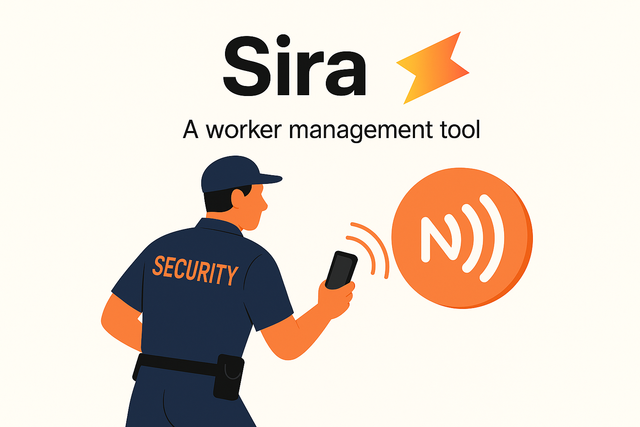
NFC tags are small, waterproof devices that contain a unique identifier. They require no battery, work in all weather conditions, and last for years. They're the same technology used in contactless payment cards and modern access control systems.
The key advantage: NFC tags require physical proximity. A smartphone must be within 1-2 inches to scan the tag. This proves the guard was physically present at that exact location—not just nearby.
Creating Patrol Routes
Setting up NFC patrol routes is straightforward:
-
Install NFC tags at critical checkpoints:
- Emergency exits
- Equipment rooms
- Perimeter fencing
- Parking structures
- High-value areas
-
Define the route in your patrol management system:
- Specify which checkpoints guards must scan
- Set the order and requirements
-
Set the sequence:
- Linear routes (checkpoint 1, 2, 3, 4)
- Flexible routes (scan all checkpoints in any order)
-
Assign to guards:
- Each guard receives their patrol schedule through the mobile app
Guards simply open the app and tap their phone to each NFC tag as they complete their route. The system instantly records the timestamp, location, and guard identity.
💡 Pro Tip: Start with 8-12 checkpoints per route. Too few won't verify coverage; too many becomes burdensome and reduces compliance.
Time-Bound Checkpoints & Automated Alerts
The real power comes from time-based monitoring. Each checkpoint can have a required completion window—typically 1 hour between scans.
If a guard misses a checkpoint or exceeds the time limit, the system automatically sends alerts to supervisors and security managers. No manual monitoring required.
Example alert notification:
This enables immediate intervention if:
- A guard is incapacitated or needs assistance
- A guard is deviating from assigned routes
- Security coverage gaps develop during the shift
⚠️ Important: Set realistic time windows. Most facilities use 45-60 minute limits for indoor routes, 90 minutes for large outdoor properties.
Automated Security Patrol Management with Sira
Managing NFC patrol systems manually—configuring routes, monitoring alerts, generating reports—becomes time-consuming as you scale.
Sira automates the entire patrol management workflow:
- Intelligent route scheduling: Auto-assign patrol routes based on shift schedules and property requirements
- Real-time monitoring dashboard: See all active patrols, missed checkpoints, and guard locations at a glance
- Configurable alert rules: Set custom time limits per checkpoint and choose who receives notifications
- Incident documentation: Guards attach photos and notes to checkpoint scans when they observe issues
- Automated compliance reports: Generate patrol completion reports for clients and regulators automatically
- Performance analytics: Track completion rates, timing patterns, and identify guards who need additional training
The system handles the complexity while giving you complete visibility and control.
✅ Result: Security teams using Sira report 94% average patrol completion rates and 80%+ reduction in missed checkpoints versus paper-based systems.
Get Started with Automated Patrol Verification
NFC technology combined with intelligent automation transforms security patrol management from a trust-based system to one with complete transparency and accountability.
Guards can prove they're doing thorough work. Supervisors get instant visibility into patrol completion. Property owners have documentation that protects against liability.
Ready to eliminate manual patrol tracking? See how Sira's automated patrol management system provides accountability, real-time monitoring, and compliance documentation. Schedule a demo to see the platform in action.
💡 Pro Tip: Start with a 30-day pilot program on one property. This lets you refine checkpoint placement, adjust time limits, and gather guard feedback before rolling out across your entire operation.